Legend of Zelda Breath of the Wild Character Concept Art
| The Legend of Zelda: Twilight Princess | |
|---|---|
 Packaging artwork, featuring Link in his Hylian and wolf forms | |
| Programmer(s) | Nintendo EAD |
| Publisher(s) | Nintendo |
| Managing director(s) | Eiji Aonuma |
| Producer(s) | Shigeru Miyamoto |
| Artist(s) |
|
| Writer(southward) |
|
| Composer(s) |
|
| Serial | The Legend of Zelda |
| Platform(due south) |
|
| Release | Wii
|
| Genre(southward) | Action-run a risk |
| Mode(southward) | Single-player |
The Fable of Zelda: Twilight Princess [a] is a 2006 action-take a chance game developed and published by Nintendo for the GameCube and Wii home video game consoles. Originally planned for release exclusively on the GameCube in Nov 2005, Twilight Princess was delayed by Nintendo to allow its developers to refine the game, add more content, and port information technology to the Wii.[4] The Wii version was a launch game in Due north America in November 2006, and in Japan, Europe, and Australia the post-obit month. The GameCube version too released in Dec 2006 as the last kickoff-political party game for the console.[v] [b]
The story focuses on series protagonist Link, who tries to prevent Hyrule from being engulfed by a corrupted parallel dimension known as the Twilight Realm. To do so, he takes the form of both a Hylian and a wolf, and he is assisted past a mysterious creature named Midna. The game takes place hundreds of years afterward Ocarina of Time and between Majora's Mask and 4 Swords Adventures, in an alternate timeline from The Wind Waker.[6]
Twilight Princess was critically acclaimed upon its release and received numerous game of the year awards. By 2015, it had sold 8.85 one thousand thousand copies worldwide, making it the acknowledged Zelda game until being overtaken by Jiff of the Wild in April 2018.[vii] In 2011, the Wii version was rereleased nether the Nintendo Selects label. A loftier-definition remaster for the Wii U, The Legend of Zelda: Twilight Princess HD, was released in March 2016.[8]
Gameplay [edit]
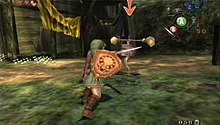
An arrow points at an enemy whom Link is targeting as he prepares to swing his sword (GameCube version).
The Legend of Zelda: Twilight Princess is an activeness-adventure game focused on gainsay, exploration, and puzzle-solving. Information technology uses the basic command scheme introduced in Ocarina of Fourth dimension, including context-sensitive action buttons and L-targeting (Z-targeting on the Wii),[ix] a system that allows the player to keep Link's view focused on an enemy or of import object while moving and attacking. Link tin walk, run, and assail, and he will automatically jump when running off of or reaching for a ledge.[c] Link uses a sword and shield in combat, complemented with secondary weapons and items, including a bow and arrows, a boomerang, and bombs.[d] While L-targeting, projectile-based weapons can be fired at a target without the need for manual aiming.[c]
The context-sensitive push button mechanic allows one button to serve a variety of functions, such as talking, opening doors, and pushing, pulling, and throwing objects.[eastward] The on-screen brandish shows what activity, if whatever, the button volition trigger, determined by the situation. For example, if Link is holding a rock, the context-sensitive button will cause Link to throw the rock if he is moving or targeting an object or enemy, or place the rock on the ground if he is continuing still.[f]
The GameCube and Wii versions feature several minor differences in their controls. The Wii version of the game makes employ of the motion sensors and built-in speaker of the Wii Remote. The speaker emits the sounds of a bowstring when shooting an arrow, Midna's laugh when she gives advice to Link, and the series' trademark "chime" when discovering secrets. The player controls Link'southward sword past swinging the Wii Remote. Other attacks are triggered using like gestures with the Nunchuk. Unique to the GameCube version is the ability for the thespian to control the photographic camera freely, without entering a special "lookaround" mode required by the Wii; however, in the GameCube version, only two of Link's secondary weapons can be equipped at a time, as opposed to four in the Wii version.[thousand]
The game features ix dungeons—large, contained areas where Link battles enemies, collects items, and solves puzzles. Link navigates these dungeons and fights a dominate at the end in gild to obtain an item or otherwise advance the plot. The dungeons are continued by a big overworld, across which Link can travel on pes; on his horse, Epona; or by teleporting with Midna'south assist.[10]
When Link enters the Twilight Realm, the void that corrupts parts of Hyrule, he transforms into a wolf.[h] He is eventually able to transform between his Hylian and wolf forms at will. As a wolf, Link loses the ability to utilise his sword, shield, or any secondary items; he instead attacks past biting and defends primarily by dodging attacks. However, "Wolf Link" gains several primal advantages in render—he moves faster than he does as a human (though riding Epona is still faster), digs holes to create new passages and uncover buried items, and has improved senses, including the ability to follow aroma trails.[i] On his back, he besides carries Midna, a pocket-size imp-similar brute who gives him hints, uses an energy field to attack enemies, helps him spring long distances, and somewhen allows him to "warp" to whatever of several preset locations throughout the overworld.[j] Using Link's wolf senses, the player tin run into and listen to the wandering spirits of those affected by the Twilight, too as chase for enemy ghosts named Poes.[k]
The artificial intelligence (AI) of enemies in Twilight Princess is more than advanced than that of enemies in The Wind Waker. Enemies react to defeated companions and to arrows or slingshot pellets that laissez passer past, and they tin can detect Link from a greater distance than was possible in previous games.[eleven]
Plot [edit]
The game begins with a teenage boy named Link, who works as a ranch hand in Ordon Village. One day, Bulblins have away the village'south children. Link pursues and encounters a wall of Twilight. A Twilight monster pulls him beyond the wall into the Twilight-shrouded wood, where he is transformed into a wolf and imprisoned. Link is soon freed past a creature named Midna, who offers to assistance him if he obeys her unconditionally. She guides him to Princess Zelda, who explains that Zant, the Wizard/Usurper Male monarch of the Twili, invaded Hyrule Castle and forced her to surrender. The kingdom became enveloped in Twilight, turning all its inhabitants too Link and Zelda into invisible spirits.[12] To save Hyrule, Link, aided by Midna, must first revive the Light Spirits by entering the Twilight-covered regions and recovering the Spirits' light from the Twilight beings that had stolen information technology. Once revitalized, each Spirit returns Link to his Hylian form and informs Link and Midna of the hidden location of a Fused Shadow, ane of the fragments of a powerful relic that volition have to be used to match Zant's power to defeat him. During this fourth dimension, the ghost of a departed swordsman, the Hero'southward Shade, also appears to provide swordsmanship training he had failed to pass on earlier his untimely death, every bit well as information regarding Link'due south destiny in Hyrule.
During his journey, Link too finds Ordon Village's children and assists the monkeys of Faron, the Gorons of Eldin, and the Zoras of Lanayru. Later restoring the Calorie-free Spirits and obtaining the Fused Shadows, Link and Midna are ambushed by Zant, who takes away the fragments. Midna calls him out for abusing his tribe'south magic, simply Zant reveals that his power comes from another source, and he uses it to trap Link in his wolf state. Failing to persuade Midna into joining forces with him, Zant attempts to dispose of her past exposing her to the light of Lanayru's lite spirit. Bringing a dying Midna to Zelda, Link learns from her that he needs the Master Sword to remove Zant's expletive and she gain to sacrifice herself to heal Midna, vanishing mysteriously. Moved by Zelda's human activity of selflessness, Midna starts to care more about Link and the fate of his world.[13]
Later gaining the Master Sword, Link is cleansed of the curse that kept him in wolf form. Deep within the Gerudo Desert, Link and Midna search for the Mirror of Twilight, the only known gateway betwixt Hyrule and the Twilight Realm, only discover that information technology is broken.[xiv] The Sages at that place explain that Zant tried to destroy it, but just managed to shatter it into fragments; only the true ruler of the Twili can completely destroy the mirror.[fifteen] They as well relate that they once used it to banish Ganondorf, the Gerudo leader who attempted to steal the Triforce, to the Twilight Realm afterwards declining to execute him. Link and Midna set out to remember the missing shards of the mirror. Once it has been fully restored, the Sages reveal to Link that Midna is actually the truthful ruler of the Twili, usurped and cursed into her current form by Zant.[16] Confronting Zant, Link and Midna larn that he forged a pact with Ganondorf, who asked for his assistance in subjugating Hyrule. After Link defeats Zant, Midna recovers the Fused Shadows and destroys Zant afterwards learning that but Ganondorf'due south defeat can release her from her expletive.
Returning to Hyrule, Link and Midna detect Ganondorf in Hyrule Castle, with a lifeless Zelda suspended above him. Ganondorf fights Link by possessing Zelda and then transforming into a gigantic boar-like beast, but Link defeats him, and the power Midna received from Zelda is able to resuscitate her. Ganondorf revives, and Midna teleports Link and Zelda exterior the castle so she tin can hold him off with the Fused Shadows. However, equally Hyrule Castle collapses, Ganondorf emerges from it victorious, crushing the Fused Shadow piece that Midna wore on her head, and pursues Link on horseback. Assisted by Zelda and the Low-cal Spirits, Link eventually knocks Ganondorf off his horse and duels him on pes before finishing him off with the Master Sword. With Ganondorf defeated, the Light Spirits revive Midna and restore her to her true course. After bidding farewell to Link and Zelda, Midna returns home and destroys the Mirror of Twilight, ultimately severing the link between Hyrule and the Twilight Realm.[17] As Hyrule Castle is rebuilt, Link leaves Ordon Hamlet, heading to parts unknown.
Evolution [edit]
Creation [edit]

In 2003, Nintendo announced that a new The Fable of Zelda game was in the works for the GameCube[18] by the same squad that had created the cel-shaded The Air current Waker.[19] At the following year's Game Developers Conference, managing director Eiji Aonuma unintentionally revealed that the game's sequel was in development under the working title The Wind Waker 2;[20] it was set to use a like graphical mode to that of its predecessor.[21] Nintendo of America told Aonuma that Due north American sales of The Air current Waker were sluggish because its drawing appearance created the impression that the game was designed for a young audience. Concerned that the sequel would have the aforementioned problem, Aonuma expressed to producer Shigeru Miyamoto that he wanted to create a realistic Zelda game that would entreatment to the North American market. Miyamoto, hesitant almost solely changing the game's presentation, suggested the team's focus should instead be on coming up with gameplay innovations. He advised that Aonuma should start by doing what could not exist done in Ocarina of Time, peculiarly horseback combat.[l] Early on development of what would go Twilight Princess began and special care was taken to improve the realism of the horseriding, with lead character designer Keisuke Nishimori riding a equus caballus for himself to experience what information technology was similar.[22]
But every bit the original Legend of Zelda game was inspired by J. R. R. Tolkien's The Lord of the Rings novels,[23] [24] the aesthetic of Twilight Princess was inspired by the Lord of the Rings films as they had just come out and were very pop at the time.[25] The game was developed with having a big disarming world in mind, one with a vast scale to meet the expectation for fantasy worlds that audiences had become accepted to with the Lord of the Rings.[26]
In four months, Aonuma's team managed to present realistic horseback riding,[l] which Nintendo subsequently revealed to the public with a trailer at Electronic Entertainment Expo 2004 and was met with enormous praise. The game was scheduled to be released the side by side year and was no longer a follow-upwardly to The Current of air Waker;[27] a true sequel to it was released for the Nintendo DS in 2007, in the form of Phantom Hourglass. Miyamoto explained in interviews that the graphical mode was chosen to satisfy need and that it better fit the theme of an older incarnation of Link.[28] The game runs on a modified The Wind Waker engine.[29]
Prior Zelda games have employed a theme of 2 separate, nonetheless connected, worlds. In A Link to the Past, Link travels between a "Low-cal World" and a "Nighttime World"; in Ocarina of Time, as well as in Oracle of Ages, Link travels between two different time periods. The Zelda squad sought to reuse this motif in the serial' latest installment. It was suggested that Link transform into a wolf, much like he metamorphoses into a rabbit in the Dark World of A Link to the Past.[m] The concept for Link to transform into a wolf and its surrounding narrative elements came from a dream that Aonuma had while overseas on a business concern trip. He dreamt that he was a wolf, locked inside a cage, and, afterward he woke up, he was dislocated and disoriented and it took a while for him to think where he was.[22] The story of the game was created by Aonuma, and it afterwards underwent several changes by scenario writers Mitsuhiro Takano and Aya Kyogoku.[1] [2] Takano created the script for the story scenes,[1] while Kyogoku and Takayuki Ikkaku handled the actual in-game script.[30] Originally, Link was planned to be a wolf from the game's start to frankly contrast the Ocarina of Time formula, but this was inverse and so that new players could be eased into Zelda'south traditional gameplay and narrative formula. The narrative premise in the story regarding the children of Ordon hamlet getting kidnapped was an case of the game featuring darker story elements than any past iteration.[22]
From a gameplay perspective, the "twilight world" portions of the game were vaguely inspired by the fact that prior Zelda games had always distinctively separated its dungeons from its overworld. It was wondered what the result would be if you took a traditional Zelda dungeon and put information technology inside the open world instead. This resulted in the hunt for tears of calorie-free the role player partakes in when in the twilight covered world. Regarding the atmosphere of the Twilight covered Hyrule, as well as the Twilight Realm dungeon later in the game, the intent was to brand players feel uncomfortable, however special intendance was taken to ensure that this was balanced right, so that information technology did not make the histrion then uncomfortable that they did not want to progress further or could non savor the experience.[22]
Aonuma left his team working on the new idea while he produced The Minish Cap for the Game Male child Advance. When he returned, he constitute the Twilight Princess team struggling. Emphasis on the parallel worlds and the wolf transformation had made Link'south character unbelievable. Aonuma also felt the gameplay lacked the quotient of innovation found in Phantom Hourglass, which was being adult with touch controls for the Nintendo DS. At the same time, the Wii was under evolution with the code proper name "Revolution". Miyamoto thought that the Revolution'southward pointing device, the Wii Remote, was well suited for aiming arrows in Zelda, and he suggested that Aonuma consider using information technology.[north]
Wii transition [edit]
Aonuma had anticipated creating a Zelda game for what would later be for the Wii, just had causeless that he would need to complete Twilight Princess first. His squad began piece of work developing a pointing-based interface for the bow and pointer, and Aonuma found that aiming directly at the screen gave the game a new feel, just like the DS control scheme for Phantom Hourglass. Aonuma felt confident this was the only fashion to keep, but worried about consumers who had been anticipating a GameCube release. Developing 2 versions would mean delaying the previously appear 2005 release, yet disappointing the consumer. Satoru Iwata felt that having both versions would satisfy users in the terminate, even though they would take to wait for the finished production. Aonuma then started working on both versions in parallel.[o]
Transferring GameCube development to the Wii was relatively simple, since the Wii was being created to be uniform with the GameCube.[o] At E3 2005, Nintendo released a modest number of Nintendo DS game cards containing a preview trailer for Twilight Princess.[31] They also announced that Zelda would appear on the Wii (then codenamed "Revolution"),[32] but it was not articulate to the media if this meant Twilight Princess or a different game.[33]
The team worked on a Wii control scheme, adapting camera control and the fighting mechanics to the new interface. A prototype was created that used a swinging gesture to control the sword from a first-person viewpoint, merely was unable to show the diversity of Link's movements. When the third-person view was restored, Aonuma thought it felt strange to swing the Wii Remote with the right manus to control the sword in Link's left paw, so the entire Wii version map was mirrored.[p] Details about Wii controls began to surface in Dec 2005 when British publication NGC Magazine claimed that when a GameCube copy of Twilight Princess was played on the Revolution, information technology would give the player the selection of using the Revolution controller.[34] Miyamoto confirmed the Revolution controller-functionality in an interview with Nintendo of Europe[35] and Time reported this soon afterward.[36] [37] However, back up for the Wii controller did non make it into the GameCube release. At E3 2006, Nintendo announced that both versions would be available at the Wii launch,[38] and had a playable version of Twilight Princess for the Wii.[p] Later, the GameCube release was pushed back to a month after the launch of the Wii.[39]
Nintendo staff members reported that demo users complained well-nigh the difficulty of the control scheme. Aonuma realized that his squad had implemented Wii controls under the mindset of "forcing" users to adapt, instead of making the system intuitive and easy to use. He began rethinking the controls with Miyamoto to focus on comfort and ease.[q] The camera motility was reworked and detail controls were inverse to avoid accidental button presses.[r] In addition, the new item system required use of the button that had previously been used for the sword. To solve this, sword controls were transferred back to gestures—something E3 attendees had commented they would like to meet. This reintroduced the problem of using a right-handed swing to control a left-handed sword attack. The squad did not take enough time before release to rework Link's graphic symbol model, then they instead flipped the entire game—everything was fabricated a mirror image.[southward] Link was now right-handed, and references to "eastward" and "west" were reversed. The GameCube version, however, was left with the original orientation. The Twilight Princess player'due south guide focuses on the Wii version, but has a section in the back with mirror-image maps for GameCube users.[t]
Music and sound [edit]
The game'due south score was equanimous past Toru Minegishi and Asuka Ohta, with series regular Koji Kondo serving as the audio supervisor.[40] Minegishi took charge of composition and sound design in Twilight Princess, providing all field and dungeon music.[41] For the trailers, three pieces were written by different composers,[42] ii of which were created by Mahito Yokota and Kondo.[43] Michiru Ōshima created orchestral arrangements for the three compositions, later to be performed by an ensemble conducted by Taizo Takemoto.[42] Kondo's piece was called as music for the E3 2005 trailer and for the demo movie after the title screen.[43] Midna has the most voice acting—her on-screen dialogue is often accompanied by a babble of pseudo-speech communication, which was produced by scrambling English phrases sampled by Japanese voice extra Akiko Kōmoto.[44]
Media requests at the trade show prompted Kondo to consider using orchestral music for the other tracks in the game likewise, a notion reinforced by his preference for live instruments.[42] He originally envisioned a full l-person orchestra for action sequences and a string quartet for more "lyrical moments",[42] though the terminal product used sequenced music instead.[10] Kondo afterward cited the lack of interactivity that comes with orchestral music equally one of the main reasons for the decision.[43] Both six- and seven-track versions of the game'south soundtrack were released on November 19, 2006, as part of a Nintendo Power promotion and arranged with replicas of the Master Sword and the Hylian Shield.[45]
Technical issues [edit]
Following the discovery of a buffer overflow vulnerability in the Wii version of Twilight Princess, an exploit known as the "Twilight Hack" was developed, allowing the execution of custom code from a Secure Digital (SD) bill of fare on the console. A specifically designed salvage file would cause the game to load unsigned code, which could include Executable and Linkable Format (ELF) programs and homebrew Wii applications.[46] Versions 3.three and 3.iv of the Wii Menu prevented copying exploited save files onto the console until circumvention methods were discovered,[47] [48] and version 4.0 of the Wii Card patched the vulnerability.[49]
Wii U version [edit]
| The Fable of Zelda: Twilight Princess Hard disk | |
|---|---|
| Developer(s) |
|
| Publisher(due south) | Nintendo |
| Manager(s) | Tomomi Sano |
| Producer(due south) | Eiji Aonuma |
| Programmer(southward) | Sean O'Sullivan |
| Artist(s) | Paul Court |
| Composer(s) |
|
| Platform(south) | Wii U |
| Release |
|
A loftier-definition remaster of the game, The Legend of Zelda: Twilight Princess HD, was developed past Tantalus Media for the Wii U. Appear during a Nintendo Directly presentation on November 12, 2015, information technology features enhanced graphics and Amiibo functionality.[eight] The game was released in North America and Europe on March 4, 2016; in Commonwealth of australia on March v, 2016;[50] and in Japan on March x, 2016.[51]
The idea for a loftier-definition version of Twilight Princess beginning originated during the product of The Legend of Zelda: Jiff of the Wild. Nintendo experimented with an HD version of Twilight Princess running on Wii U development kits when trying to settle on a graphical style for the new game.[52] This ultimately led to the production of The Air current Waker Hard disk drive, whose success encouraged the Zelda team to pursue other high-definition remasters. Afterwards its release, which was developed internally at Nintendo in only vi months, the Zelda team settled on an HD remaster of Twilight Princess. At the fourth dimension, most of the Zelda team was preoccupied with Breath of the Wild, and so Nintendo sought a partnership with an external development studio, the Australia-based Tantalus Media, to work on Twilight Princess Hard disk.[53]
Co-ordinate to Eiji Aonuma, who directed the original release and produced Twilight Princess HD, ensuring the remaster would take reward of the Wii U GamePad was a point of focus early in the championship's development. The control scheme used in the GameCube version was adjusted for the remaster due to similarities betwixt the button layouts of the two consoles' controllers.[53] Aonuma considered underwater gameplay in the remaster significantly improved. Other enhancements include speeding up a scattering of cutscenes that seemed overly long by mod standards[53] and reducing repetitive gameplay elements, such equally collecting Tears of Calorie-free while in the Twilight Realm.[54] A commitment to "preserving the feel of the original" inspired several design decisions, such as keeping the frame rate at 30 frames per second.[53] Tomomi Sano, the banana manager of the Wii U version, noted the caste of refinement the graphics would receive required much consideration: "When nosotros created more precise models of objects to go with the higher resolution, we found that everything was as well clear and we lost that soft and fragile atmosphere that you get in particular at twilight or with the light in a woods."[53]
Certain bundles of the game contain a Wolf Link Amiibo figurine, which unlocks a Wii U-sectional dungeon called the "Cave of Shadows"[55] and can carry data over to The Legend of Zelda: Jiff of the Wild.[56] In the Cavern of Shadows, Link fights waves of enemies while restricted to his wolf class.[55] Comparable to the optional "Cave of Ordeals" nowadays in the original release, opportunities to recover wellness during the trial are sparse.[57] Other Zelda-related Amiibo figurines accept singled-out functions: Link and Toon Link furnish arrows, Zelda and Sheik restore Link's health, and Ganondorf causes Link to take twice as much damage.[55] A CD containing xx musical selections from the game was available as a GameStop preorder bonus in North America; it is included with the express-edition bundle in other regions.[58] A 3-disc original soundtrack consisting of 108 pieces from the game was released in Japan in July 2016.[59]
Reception [edit]
Reviews [edit]
Twilight Princess was released to critical acclaim and commercial success. It received perfect scores from major publications such as 1UP.com,[62] Computer and Video Games,[65] Electronic Gaming Monthly,[67] Game Informer,[69] GamesRadar [73] and GameSpy.[74] On the review aggregator Metacritic, Twilight Princess holds scores of 95/100 for the Wii version and 96/100 for the GameCube version, indicating "universal acclaim".[60] [61] It is the highest-rated game of 2006 on Metacritic.[81] GameTrailers in their review called it one of the greatest games ever created.[82]
On release, Twilight Princess was considered to be the greatest Zelda game always made past many critics including writers for 1UP.com,[62] Computer and Video Games,[65] Electronic Gaming Monthly,[67] Game Informer,[69] GamesRadar,[73] IGN [10] and The Washington Mail service.[83] Game Informer called information technology "so creative that it rivals the all-time that Hollywood has to offer".[69] GamesRadar praised Twilight Princess as "a game that deserves null just the absolute highest recommendation".[73] Cubed3 hailed Twilight Princess as "the single greatest videogame experience".[84] Twilight Princess ' graphics were praised for the art mode and animation, although the game was designed for the GameCube, which is technically lacking compared to the next generation consoles. Both IGN and GameSpy pointed out the existence of blurry textures and low-resolution characters.[10] [74] Despite these complaints, Estimator and Video Games felt the game's atmosphere was superior to that of any previous Zelda game and regarded Twilight Princess ' Hyrule equally the all-time version ever created.[65] PALGN praised the game's cine, noting that "the cutscenes are the best e'er in Zelda games".[85] Regarding the Wii version, GameSpot 's Jeff Gerstmann said the Wii controls felt "tacked-on",[71] although 1UP.com said the remote-swinging sword attacks were "the most impressive in the unabridged series".[62] Gaming Nexus considered Twilight Princess ' soundtrack to be the all-time of this generation,[86] though IGN criticized its MIDI-formatted songs for lacking "the punch and crispness" of their orchestrated counterparts.[10]
Awards [edit]
Twilight Princess received the awards for Best Creative Design,[87] Best Original Score,[88] and All-time Utilise of Sound[89] from IGN for its GameCube version. Both IGN and Nintendo Power gave Twilight Princess the awards for Best Graphics[ninety] [91] [92] and Best Story.[92] [93] [94] It also received the 2007 award for "Outstanding Achievement in Story and Grapheme Evolution" from the Academy of Interactive Arts & Sciences.[95] Twilight Princess received Game of the Yr awards from GameTrailers,[96] 1UP.com,[97] Electronic Gaming Monthly,[98] Game Informer,[99] Games Radar,[100] GameSpy,[101] Spacey Awards,[102] X-Play [103] and Nintendo Ability.[92] Information technology was too given awards for Best Risk Game from the Game Critics Awards,[104] X-Play,[103] IGN,[105] [106] GameTrailers,[107] 1UP.com,[97] and Nintendo Power.[92] The game was considered the Best Console Game by the Game Critics Awards[104] and GameSpy.[101] The game placed 16th in Official Nintendo Magazine 's listing of the 100 Greatest Nintendo Games of All Time.[108] IGN ranked the game as the 4th-best Wii game.[109] Nintendo Power ranked the game as the third-best game to exist released on a Nintendo arrangement in the 2000s decade.[110]
Sales [edit]
In North America, the game was sold with iii of every four Wii purchases during its first calendar week.[111] The Wii version sold 412,000 copies in the Usa during November 2006, representing 87% of Wii launch sales that calendar month, the highest attach rate for a launch game since Super Mario 64 launched with the Nintendo 64 in 1996.[112] It went on to become America's 5th best-selling game of 2006 with 1.v one thousand thousand copies sold for the Wii and GameCube in the US that year.[113] In the United kingdom of great britain and northern ireland, the Wii version received a Platinum sales laurels from the Entertainment and Leisure Software Publishers Clan (ELSPA),[114] indicating sales of at to the lowest degree 300,000 copies in the UK.[115]
The game had sold five.82 one thousand thousand copies on the Wii equally of March 31, 2011[update],[116] and ane.32 million on the GameCube as of March 31, 2007[update].[117] As of September 30, 2015[update], the game had sold eight.85 million copies worldwide across both platforms,[118] making it the best-selling single title in the series until it was surpassed by The Legend of Zelda: Breath of the Wild (2017).[119]
Twilight Princess Hard disk drive [edit]
Twilight Princess Hd holds a score of 86/100 at the review aggregator Metacritic, indicating "by and large favorable" reviews.[120] The championship received the Nintendo Game of the Year award at the Gilt Joystick Awards in November 2016.[121]
The remaster sold 52,282 copies during its outset week of release in Japan, which placed it at 2nd identify in the video game sales charts.[122] The following week, it came in at number nine on the charts, selling an additional 7,705 copies.[123] By comparison, 30,264 copies of The Wind Waker Hard disk were sold in its offset week in Japan.[124] In the outset calendar week of Twilight Princess Hard disk 's United Kingdom release, the remaster was the 2d all-time-selling game and the best-selling game released for a single platform in the country.[125] Twilight Princess HD 'south sales dropped 84% in its second week in the U.K., making information technology the ninth all-time-selling game in the state.[126] In the United States, it was the third best-selling game sold in brick-and-mortar retailers throughout March 2016, according to market-research firm The NPD Grouping.[127]
Legacy [edit]
A manga series based on Twilight Princess, penned and illustrated by Akira Himekawa, was first released in Nihon on February viii, 2016 and ran until Jan xxx, 2022. The serial is available solely via publisher Shogakukan'southward MangaOne mobile application. While the manga adaptation began most ten years after the initial release of the game on which it is based, information technology launched merely a month before the release of the high-definition remake.[128] Viz Media began releasing an English localization of the serial in 2017.[129]
To commemorate the launch of the My Nintendo loyalty program in March 2016, Nintendo released My Nintendo Picross: The Fable of Zelda: Twilight Princess, a Picross puzzle game developed by Jupiter for download to the Nintendo 3DS.[130] [131]
Midna; in both her imp and Twili forms, Zant, and NPC character Agitha, all appeared as playable warriors in the Zelda crossover title Hyrule Warriors and its various iterations.[132] Since the release of Hyrule Warriors, Agitha has been recognised as a "chief graphic symbol" of Twilight Princess.[133]
See also [edit]
- Link's Crossbow Training, a 2007 shooting video game created for the Wii Zapper, using the globe and assets of Twilight Princess
Notes [edit]
- ^ Known in Japan as Zelda no Densetsu: Twilight Princess (Japanese: ゼルダの伝説 トワイライトプリンセス, Hepburn: Zeruda no Densetsu: Towairaito Purinsesu ).
- ^ Aonuma 2007, Eiji Aonuma's GDC 2007 Presentation
- ^ a b Pelland 2006, p. xx
- ^ Pelland 2006, pp. 22–23
- ^ Pelland 2006, p. 22
- ^ Pelland 2006, p. 12
- ^ Pelland 2006, p. 168
- ^ Pelland 2006, p. 35
- ^ Pelland 2006, pp. 17–20
- ^ Pelland 2006, p. 21
- ^ Pelland 2006, p. 153
- ^ a b Aonuma 2007, The fate of Current of air Waker 2
- ^ Aonuma 2007, A lupine direction and Minish Cap
- ^ Aonuma 2007, E3 2005 and 120% Zelda
- ^ a b Aonuma 2007, A Revolutionary idea
- ^ a b Aonuma 2007, The first effort at Wii command
- ^ Aonuma 2007, E3 2006 lesson
- ^ Aonuma 2007, Camera and detail controls
- ^ Aonuma 2007, Sword controls
- ^ Pelland 2006, pp. 170–191
References [edit]
- Aonuma, Eiji (March 2007). The Legend of Zelda: Twilight Reflections in the Hourglass (Spoken language). Game Developers Briefing. Archived from the original on April 20, 2014. Retrieved September 12, 2008 – via Nintendo Earth Study.
- Pelland, Scott, ed. (November 19, 2006). Official Nintendo Ability The Legend of Zelda: Twilight Princess Player's Guide. Nintendo. ISBN1-59812-004-2.
- ^ a b c "Iwata Asks : The Legend of Zelda: Twilight Princess : Similar Trying to Mold Clay". Iwata Asks. Nintendo. November 2006. Archived from the original on July 25, 2015. Retrieved Apr half-dozen, 2015.
Mitsuhiro Takano: My proper name is Takano. I was basically in charge of the story scripting for Twilight Princess, but I was also involved in the evolution of the cutting-scenes and a few of the events in the game.
- ^ a b 勝田哲也 (March seven, 2007). "Game Developers Choice Awards、All-time GAMEは「Gears of War」". GAME Spotter (in Japanese). Impress Watch Corporation. Archived from the original on January 8, 2011. Retrieved June 27, 2010.
Eiji Aonuma: 僕が書いたストーリーをものすごく良いものに変えてくれたシナリオ担当の高野充浩さんと京極あやさん / Those responsible for the scenario, Mr. Mitsuhiro Takano and Mrs. Aya Kyogoku, fabricated some really corking changes to the story I wrote [...]
- ^ Lawler, Richard.Nintendo Wii, GameCube games come to China on NVIDIA Shield.Engadget.2017-12-05.[2017-12-05].
- ^ Casamassina, Matt (August 16, 2005). "Zelda Delayed to Adjacent Year". IGN. Ziff Davis. Archived from the original on May 12, 2006. Retrieved November 13, 2021.
- ^ "GamePro Q&A: Nintendo's Harrison on Zelda". GamePro. IDG Entertainment. November five, 2006. Archived from the original on November 26, 2006. Retrieved December 3, 2006.
- ^ "Long interview with Eiji Aonuma". Nintendo Dream (in Japanese). February 2007. Archived from the original on Feb 2, 2007. Retrieved February 3, 2016.
- ^ Nunneley, Stephany (Apr 26, 2018). "Switch sales stand at over 17M units, Breath of the Wild now all-time-selling Zelda championship". VG247 . Retrieved Apr 27, 2018.
- ^ a b Otero, Jose (November 12, 2015). "The Legend of Zelda: Twilight Princess HD Announced for Wii U". IGN. Ziff Davis. Archived from the original on November 15, 2015. Retrieved November xiv, 2015.
- ^ Kaluszka, Aaron (January 11, 2007). "GC Review: The Legend of Zelda: Twilight Princess". Nintendo World Study. Archived from the original on February 28, 2009. Retrieved January 23, 2009.
- ^ a b c d due east f Casamassina, Matt (November 17, 2006). "The Legend of Zelda: Twilight Princess Review". IGN. Ziff Davis. Archived from the original on January 12, 2017. Retrieved April 27, 2017.
- ^ "Inside Zelda part ten: The Monsters in his Caput". Nintendo Power. Nintendo. 201: 46–48. March 2006. Archived from the original on September 13, 2008. Retrieved September x, 2008.
- ^ Nintendo Entertainment Analysis & Development (November nineteen, 2006). The Legend of Zelda: Twilight Princess (GameCube/Wii). Nintendo.
Midna: Poor thing, he has no idea where this is or what's happened... So, don't y'all think you should explicate to him what you've managed to exercise? You owe him that much... ...Twilight Princess! Eee hee! [...] / Zelda: Listen carefully... This was once the country where the power of the gods was said to slumber. This was once the kingdom of Hyrule. Simply that blessed kingdom has been transformed past the male monarch that rules the twilight... It has been turned into a world of shadows, ruled by creatures who shun the light. [...] Twilight covered Hyrule like a shroud, and without lite, the people became as spirits. Inside the twilight, they alive on, unaware that they have passed into spirit forms... All the people know at present is fear... Fright of a nameless evil... The kingdom succumbed to twilight, but I remain its princess... I am Zelda.
- ^ Nintendo Entertainment Analysis & Evolution (November nineteen, 2006). The Fable of Zelda: Twilight Princess (GameCube/Wii). Nintendo.
Midna: Princess... I have one last asking... Can you tell him...where to discover the Mirror of Twilight? [Zelda gasps] [...] / Zelda: Midna... I believe I understand at present just who and what y'all are... Despite your mortal injuries, y'all human activity in our stead... These dark times are the issue of our deeds, yet it is you who accept reaped the penalty. Take this now, Midna. I pass information technology to you lot... [...] / Midna: No! Link! End HER! [...] We get dorsum, Link! Back to the Faron Woods! [...] [to herself] Zelda...I've taken all that you had to give...though I did not want it.
- ^ Nintendo Amusement Assay & Evolution (November 19, 2006). The Fable of Zelda: Twilight Princess (GameCube/Wii). Nintendo.
Midna: Hey, but listen, Link... I've got a niggling favor to ask... Would you lot listen coming with me to find something called the Mirror of Twilight? It's hidden somewhere in Hyrule... Aye, the Mirror of Twilight... Our concluding potential link to Zant!
- ^ Nintendo Amusement Analysis & Evolution (November xix, 2006). The Legend of Zelda: Twilight Princess (GameCube/Wii). Nintendo.
Sages: Only the true leader of the Twili can utterly destroy the Mirror of Twilight...and so Zant could only break it into pieces.
- ^ Nintendo Amusement Analysis & Development (November nineteen, 2006). The Legend of Zelda: Twilight Princess (GameCube/Wii). Nintendo.
Sages: [to Midna] I hope you tin can find it in yourself to forgive our carelessness... O Twilight Princess.
- ^ Nintendo Amusement Assay & Development (Nov 19, 2006). The Fable of Zelda: Twilight Princess (GameCube/Wii). Nintendo.
Midna: Thank yous... Well, the princess spoke truly: as long every bit that mirror's around, nosotros could encounter once again... Link... I... See you later on...
- ^ "New GCN Wario Ware, Zelda". IGN. Ziff Davis. Baronial seven, 2003. Archived from the original on July xix, 2008. Retrieved September 12, 2008.
- ^ "Interview: Eiji Aonuma". IGN. Ziff Davis. May 19, 2004. Archived from the original on Jan three, 2009. Retrieved November xiii, 2021.
- ^ "GDC 2004: Wind Waker ii Official". IGN. Ziff Davis. March 24, 2004. Archived from the original on October 2, 2008. Retrieved Nov 13, 2021.
- ^ "Fact or Fiction: The ten Biggest Rumors on GameCube". IGN. Ziff Davis. Baronial 6, 2003. Archived from the original on January 3, 2009. Retrieved November 13, 2021.
- ^ a b c d The Fable of Zelda Encyclopedia. Nighttime Horse. 2018. p. 279. ISBN978-1-50670-638-two.
- ^ "Classic: Zelda und Link" [Classic: Zelda and Link]. Social club Nintendo (in High german). Vol. 1996, no. ii. Nintendo of Europe. Apr 1996. p. 72.
[The two program designers Shigeru Miyamoto and Takashi Tezuka were responsible for the game, who set themselves the goal of developing a fairytale run a risk game with action elements... ...Takashi Tezuka, a smashing lover of fantasy novels such as Tolkien'southward Lord of the Rings, wrote the script for the get-go 2 games in the Zelda series].
- ^ "Shigeru Miyamoto Interview". Super PLAY (in Swedish). Medströms Dataförlag AB (4/03). March 2003. Archived from the original on September 7, 2006. Retrieved September 24, 2006.
All ideas for The fable of Zelda were mine and Takashi Tezukas... ...Books, movies and our own lives.
- ^ Kazuya Sakai, Patrick Thorpe (February 2017). The Fable of Zelda: Fine art & Artifacts. Nighttime Horse. p. 419. ISBN978-1506703350.
Takizawa: And that was virtually the fourth dimension we heard that people were wanting a realistic looking Zelda game once again. Also at that time, there was an epic fantasy motion picture which was very popular. So after reexamining the situation, nosotros said to ourselves, 'Let's do this affair!'
- ^ Iwata, Satoru; Aonuma, Eiji (November 23, 2006). "Iwata Asks: Make it 120% Zelda!". Nintendo.
Aonuma: It's undeniably large, merely I believe all those fun elements which brand upwards this globe justify this size. Now that we have finished, I experience that with a generation accustomed to watching epic films similar Lord of the Rings, when you want to design a convincing globe, that sort of vast scale becomes necessary.
- ^ Gerstmann, Jeff (May 12, 2004). "The Legend of Zelda details". GameSpot. CBS Interactive. Archived from the original on March 27, 2009. Retrieved September 12, 2008.
- ^ "E3 2004: Miyamoto and Aonuma on Zelda". IGN. Ziff Davis. May 12, 2004. Archived from the original on Dec half dozen, 2008. Retrieved November 13, 2021.
- ^ "E3 2004: New Legend of Zelda Details". IGN. Ziff Davis. May 12, 2004. Archived from the original on September 25, 2006. Retrieved November 13, 2021.
- ^ "Iwata Asks : The Fable of Zelda: Twilight Princess : Ideas Born Out of Functionality". Iwata Asks. Nintendo. November 2006. Archived from the original on July 25, 2015. Retrieved April half dozen, 2015.
- ^ "The Legend of Zelda: Twilight Princess Preview Trailer". IGN. Ziff Davis. December 13, 2008. Archived from the original on December 29, 2008.
- ^ Casamassina, Matt (May 17, 2005). "E3 2005: Mario and Zelda Become Next-Gen". IGN. Ziff Davis. Archived from the original on June 28, 2008. Retrieved November 13, 2021.
- ^ Casamassina, Matt (February 28, 2006). "Every Revolution Game Nosotros Know Most". IGN. Ziff Davis. Archived from the original on January 1, 2009. Retrieved September 12, 2008.
- ^ Chou, Che (December 22, 2005). "Play Zelda: Twilight Princess with the Revolution Controller". 1UP.com. IGN. Archived from the original on October 13, 2012. Retrieved May 28, 2006.
- ^ "EGM Presents: The 2006 1UP Network Awards". Electronic Gaming Monthly. 2006.
- ^ Grossman, Lev (May 15, 2006). "A Game For All Ages". Time. Archived from the original on January 29, 2015. Retrieved March 12, 2015.
- ^ Thorsen, Tor (May 7, 2006). "E3 06: Zelda Wii sword fighting, next-gen WarioWare confirmed". GameSpot. CBS Interactive. Archived from the original on September 5, 2014. Retrieved May 28, 2006.
- ^ Hatfield, Daemon (May nine, 2006). "E3 2006: Wii, Gamecube Zelda Available Simultaneously". IGN. Ziff Davis. Archived from the original on January 4, 2009. Retrieved Nov 13, 2021.
- ^ Seff, Micah (September 14, 2006). "Twilight Princess Slips". IGN. Ziff Davis. Archived from the original on January three, 2009. Retrieved September 12, 2008.
- ^ Nintendo Entertainment Analysis & Development (Nov 19, 2006). The Legend of Zelda: Twilight Princess (GameCube/Wii). Nintendo. Scene: Credits sequence.
MUSIC / Toru Minegishi / Asuka Ohta / Koji Kondo
- ^ "Inside Zelda: Role 13". Nintendo Power. Nintendo. 204: 76–78. June 2006. Archived from the original on June 14, 2008. Retrieved October 17, 2007.
- ^ a b c d "Inside Zelda part iv: Natural Rhythms of Hyrule". Nintendo Power. Nintendo. 195: 56–58. September 2005. Archived from the original on August 11, 2014. Retrieved October 10, 2008.
- ^ a b c Kohler, Chris (March 11, 2007). "VGL: Koji Kondo Interview". Wired. Condé Nast. Archived from the original on March 28, 2015. Retrieved April 6, 2015.
- ^ Hillier, Brenna (July 30, 2014). "Midna speaks English, and other secrets of The Legend of Zelda". VG247. Archived from the original on August 2, 2014. Retrieved April 30, 2016.
- ^ "The Legend of Zelda: Twilight Princess Official Soundtrack". VGMdb. Archived from the original on September 4, 2009. Retrieved August 3, 2009.
- ^ Fletcher, JC (February 11, 2008). "'Twilight Hack' teases homebrew". Joystiq. AOL. Archived from the original on Jan 31, 2009. Retrieved Apr 19, 2015.
- ^ Miller, Ross (June sixteen, 2008). "New Wii menu update iii.3 nullifies Twilight Princess hack". Joystiq. AOL. Archived from the original on June 17, 2008. Retrieved April 19, 2015.
- ^ Greenhough, Chris (November 24, 2008). "Information technology lives! The Twilight Hack returns". Joystiq. AOL. Archived from the original on March ten, 2011. Retrieved April xix, 2015.
- ^ Fitzpatrick, Jason (August 21, 2009). "Hack Your Wii for Homebrew without Twilight Princess". Lifehacker. Gawker Media. Archived from the original on August 23, 2009. Retrieved April 19, 2015.
- ^ "The Fable of Zelda: Twilight Princess Hard disk drive, Hyrule Warriors: Legends, and New Nintendo 3DS XL Hyrule edition provide a Triforce of releases to start 2016". Nintendo. January 22, 2016. Archived from the original on Jan 23, 2016. Retrieved February 6, 2016.
- ^ Romano, Sal (Jan 29, 2016). "The Fable of Zelda: Twilight Princess Hd story trailer". Gematsu. Archived from the original on January thirty, 2016. Retrieved February 6, 2016.
- ^ "Breaking Conventions with The Fable of Zelda: Breath of the Wild - YouTube".
- ^ a b c d east Aonuma, Eiji; Sano, Tomomi (March 2, 2016). "Interview: Eiji Aonuma and Tomomi Sano Shed Light on The Legend of Zelda: Twilight Princess Hard disk". Nintendo Life (Interview). Interviewed past Thomas Whitehead. Gamer Network. Archived from the original on March 3, 2016. Retrieved March 5, 2016.
- ^ McElroy, Griffin (March i, 2016). "The Legend of Zelda: Twilight Princess Hard disk review". Polygon. Voice Media. Archived from the original on March one, 2016. Retrieved March 3, 2016.
- ^ a b c Otero, Jose (February 4, 2016). "The Fable of Zelda: Twilight Princess Hard disk drive Looks (and Plays) Better Than You lot Think". IGN. Ziff Davis. Archived from the original on February 4, 2016. Retrieved February 6, 2016.
- ^ Phillips, Tom (January fourteen, 2016). "Zelda: Twilight Princess Hard disk drive has a new dungeon". Eurogamer. Gamer Network. Archived from the original on January xv, 2016. Retrieved Jan 20, 2016.
- ^ Phillips, Tom (January 21, 2016). "Zelda: Twilight Princess Hard disk'southward Amiibo-exclusive dungeon revealed". Eurogamer. Gamer Network. Archived from the original on Jan 22, 2016. Retrieved March 8, 2016.
- ^ Jenni (February nineteen, 2016). "The Fable Of Zelda: Twilight Princess HD's Sound Option CD Features 20 Remastered Tracks". Siliconera. Curse, Inc. Archived from the original on March 3, 2016. Retrieved March 3, 2016.
- ^ Rosario, Kristen Thousand. (June 9, 2016). "Twilight Princess Hard disk original soundtrack to exist released in Japan on July 27th". Zelda Informer. CraveOnline. Archived from the original on August ix, 2016. Retrieved Baronial 8, 2016.
- ^ a b "The Legend of Zelda: Twilight Princess for Wii Reviews". Metacritic. CBS Interactive. Archived from the original on March 20, 2015. Retrieved April 1, 2015.
- ^ a b "The Legend of Zelda: Twilight Princess for GameCube Reviews". Metacritic. CBS Interactive. Archived from the original on November 23, 2010. Retrieved April 1, 2015.
- ^ a b c d Parish, Jeremy (Nov 16, 2006). "1up'due south Wii Review: Legend of Zelda: Twilight Princess". 1UP.com. IGN. Archived from the original on September 27, 2007. Retrieved Jan 31, 2007.
- ^ "Leged of Zelda Twilight Princess GCN 1UP Review". Archived from the original on May 25, 2016.
- ^ Reges, Julia (Oct 3, 2010). "The Legend of Zelda: Twilight Princess—Review". AllGame. All Media Network. Archived from the original on February xvi, 2010. Retrieved September 25, 2013.
- ^ a b c d Robinson, Andy (November xix, 2006). "Wii Review: Fable of Zelda: Twilight Princess". Reckoner and Video Games. Future plc. Archived from the original on May 17, 2007. Retrieved March 25, 2013.
- ^ "The Legend of Zelda: Twilight Princess Review". Edge. Futurity plc. Archived from the original on Apr 4, 2013. Retrieved March 25, 2013.
- ^ a b c Parish, Jeremy (January 2007). "The Legend of Zelda: Twilight Princess review". Electronic Gaming Monthly. 211: 56–58.
- ^ ゼルダの伝説 トワイライトプリンセス (ix / x / ix / 10). Famitsu (in Japanese). Enterbrain. Nov 24, 2006.
- ^ a b c d Reiner, Andrew. "The Legend of Zelda: Twilight Princess". Game Informer. GameStop. Archived from the original on November 29, 2006. Retrieved December 5, 2006.
- ^ Moses, Tenacious (September 5, 2010). "The Fable of Zelda: Twilight Princess Review from GamePro". GamePro. IDG Entertainment. Archived from the original on September 5, 2010. Retrieved March 25, 2013.
- ^ a b Gerstmann, Jeff (December xiv, 2006). "The Legend of Zelda: Twilight Princess Review". GameSpot. CBS Interactive. Archived from the original on December 6, 2006. Retrieved June 18, 2007.
- ^ Gerstmann, Jeff (December xiv, 2006). "The Legend of Zelda: Twilight Princess Review". GameSpot. CBS Interactive. Archived from the original on January five, 2007. Retrieved June 18, 2007.
- ^ a b c d Elston, Brett (Nov 21, 2006). "The Legend of Zelda: Twilight Princess review". GamesRadar. Time to come plc. Archived from the original on May 23, 2015. Retrieved April 6, 2015.
- ^ a b c Williams, Bryn (Nov thirteen, 2006). "The Fable of Zelda: Twilight Princess Review". GameSpy. IGN. Archived from the original on December ii, 2006. Retrieved December 5, 2006.
- ^ Casamassina, Matt (Dec 15, 2006). "The Legend of Zelda: Twilight Princess Review". IGN. Ziff Davis. Archived from the original on December 17, 2006. Retrieved November xiii, 2021.
- ^ Hoffman, Chris (January 2007). "The Strongest Link". Nintendo Power. Nintendo. 211: 98–99.
- ^ Sinfield, George (February 2007). "The Best for Last". Nintendo Power. Nintendo. 212: 95.
- ^ "The Legend of Zelda: Twilight Princess Review—Review". Nintendo World Report. November 18, 2006. Archived from the original on May 29, 2010. Retrieved March 25, 2013.
- ^ "Legend of Zelda Twilight Princess ONM Review". Archived from the original on Oct nine, 2014.
- ^ Leffler, Michael (2006). "Reviews—The Legend of Zelda: Twilight Princess". G4. Archived from the original on December 6, 2006. Retrieved March nineteen, 2007.
- ^ "All-time Video Games for 2006". Metacritic. CBS Interactive. Retrieved February 21, 2017.
- ^ "The Legend of Zelda: Twilight Princess Review". GameTrailers. Defy Media. November 21, 2006. Archived from the original on August 28, 2015. Retrieved Apr half-dozen, 2015.
- ^ McDougal, Gregory (March 16, 2007). "Zelda Brightens GameCube's Twilight Years". The Washington Post. Archived from the original on November 12, 2012. Retrieved October 17, 2008.
- ^ Temperton, James (December eight, 2006). "C3 Reviews :: The Legend of Zelda: Twilight Princess". Cubed3. Archived from the original on May 22, 2013. Retrieved October 29, 2008.
- ^ Sell, Chris (December 12, 2006). "The Fable of Zelda: Twilight Princess Review". PALGN. Archived from the original on June 16, 2007. Retrieved May 22, 2008.
- ^ Colleli, Sean (February 28, 2007). "The Legend of Zelda: Twilight Princess Review". Gaming Nexus. Archived from the original on August three, 2007. Retrieved May 22, 2008.
- ^ "IGN.com presents The Best of 2006: Gamecube: Best Artistic Design". IGN. Ziff Davis. December 21, 2006. Archived from the original on Jan x, 2007. Retrieved October 26, 2008.
- ^ "IGN.com presents The Best of 2006: Gamecube: All-time Original Score". IGN. Ziff Davis. Dec 21, 2006. Archived from the original on Jan 10, 2007. Retrieved October 26, 2008.
- ^ "IGN.com presents The Best of 2006: Gamecube: Best Use of Sound". IGN. Ziff Davis. December 21, 2006. Archived from the original on January ten, 2007. Retrieved Oct 26, 2008.
- ^ "IGN.com presents The All-time of 2006: Gamecube: Best Graphics Technology". IGN. Ziff Davis. Dec 21, 2006. Archived from the original on January ten, 2007. Retrieved October 26, 2008.
- ^ "IGN.com presents The Best of 2006: Wii: Best Graphics Technology". IGN. Ziff Davis. December 21, 2006. Archived from the original on January x, 2007. Retrieved October 26, 2008.
- ^ a b c d "2006 Nintendo Power Awards". Nintendo Ability. Nintendo. 215: fifty–56. May 2007.
- ^ "IGN.com presents The All-time of 2006: Gamecube: Best Story". IGN. Ziff Davis. December 21, 2006. Archived from the original on January ten, 2007. Retrieved October 26, 2008.
- ^ "IGN.com presents The Best of 2006: Wii: Best Story". IGN. Ziff Davis. December 21, 2006. Archived from the original on January 10, 2007. Retrieved October 26, 2008.
- ^ "2007 Awards Category Details - Outstanding Accomplishment in Story and Character Development". Academy of Interactive Arts & Sciences. Archived from the original on May 4, 2011. Retrieved February 11, 2018.
- ^ "2006 GameTrailers Awards: Game of the Yr". GameTrailers. Defy Media. January 11, 2007. Archived from the original on June 19, 2007. Retrieved September 12, 2008.
- ^ a b "The 2006 1UP Awards Winners". 1UP.com. IGN. January 31, 2007. Archived from the original on September 27, 2007. Retrieved December 29, 2008.
- ^ "The Legend of Zelda: Twilight Princess review". Electronic Gaming Monthly. 213: 77–81. March 2007.
- ^ "The Fable of Zelda: Twilight Princess review". Game Informer. Vol. 165. GameStop. January 2007. pp. 88, 102.
- ^ "GamesRadar's potentially annual Platinum Chalice awards 2006". GamesRadar. Time to come plc. December 22, 2006. Archived from the original on March 4, 2016.
- ^ a b "GameSpy's Game of the Year 2006". GameSpy. IGN. Archived from the original on December 31, 2006. Retrieved August 26, 2008.
- ^ "Favorite Video Game of 2007". Spaceys. 2007. Infinite.
- ^ a b "BEST OF '06: Action/Take a chance". G4. Archived from the original on January 19, 2007. Retrieved March 19, 2007.
- ^ a b "2005 Winners". Game Critics Awards. 2005. Archived from the original on June 23, 2009. Retrieved December 29, 2008.
- ^ "IGN.com presents The Best of 2006: Gamecube: Best Adventure Game". IGN. Ziff Davis. December 21, 2006. Archived from the original on January fourteen, 2007. Retrieved October 26, 2008.
- ^ "IGN.com presents The All-time of 2006: Wii: All-time Take chances Game". IGN. Ziff Davis. December 21, 2006. Archived from the original on January ten, 2007. Retrieved Oct 26, 2008.
- ^ "2006 GameTrailers Awards: All-time Action/Adventure Game". GameTrailers. Defy Media. January 9, 2007. Archived from the original on September 12, 2007. Retrieved September 12, 2008.
- ^ "20–xi Official Nintendo Magazine". Official Nintendo Mag. Future plc. Archived from the original on Feb 28, 2009. Retrieved February 25, 2009.
- ^ "The Top 25 Wii Games". IGN. Ziff Davis. November 26, 2009. Archived from the original on December 2, 2009. Retrieved Nov 13, 2021.
- ^ "The Best of the Decade". Nintendo Power. Future The states (252): 68–77. March 2010.
- ^ Sinclair, Brendan (November 27, 2006). "Over 600,000 Wiis served". GameSpot. CBS Interactive. Archived from the original on September 26, 2007. Retrieved Jan 7, 2007.
- ^ Gallagher, Brendan (December 7, 2006). "Nintendo of America Releases Details of November NPD". Nintendo World Report . Retrieved November 23, 2021.
- ^ Surette, Tim (Jan 16, 2007). "Madden hoists 2006 sales trophy". GameSpot . Retrieved November 23, 2021.
{{cite web}}: CS1 maint: url-status (link) - ^ "ELSPA Sales Awards: Platinum". Entertainment and Leisure Software Publishers Association. Archived from the original on May fifteen, 2009.
- ^ Caoili, Eric (November 26, 2008). "ELSPA: Wii Fit, Mario Kart Attain Diamond Status In United kingdom". Gamasutra. Archived from the original on September eighteen, 2017.
- ^ "Nintendo Annual Report 2011" (PDF). Nintendo. Baronial one, 2011. p. 13. Archived (PDF) from the original on October 17, 2011. Retrieved January 27, 2012.
- ^ "Supplementary Data most Earnings Release" (PDF). Nintendo. April 25, 2007. p. 6. Archived (PDF) from the original on September 27, 2007. Retrieved September 17, 2007.
- ^ "ゼルダの伝説 トワイライトプリンセス Hard disk drive" [The Legend of Zelda: Twilight Princess HD]. Nintendo . Retrieved November 23, 2021.
- ^ Nunneley, Stephany (April 26, 2018). "Switch sales stand at over 17M units, Breath of the Wild now best-selling Zelda title". VG247 . Retrieved December 27, 2018.
- ^ "The Legend of Zelda: Twilight Princess HD for Wii U Reviews". Metacritic. CBS Interactive. 2016. Retrieved April 19, 2016.
- ^ Whitehead, Thomas (November 18, 2016). "Eiji Aonuma Wins Gilded Joystick Lifetime Achievement Award as Pokémon Get Picks Up Two Gongs". Nintendo Life. Gamer Network. Retrieved November 19, 2016.
- ^ Sato (March 16, 2016). "This Week In Sales: The Division Raids In, Twilight Princess Hd And Summon Nighttime half dozen Follows". Siliconera. Retrieved Feb 25, 2017.
- ^ Sato (March 23, 2016). "This Week In Sales: Pokkén Tournament Brings The Fight, Digimon World Follows". Siliconera. Retrieved February 25, 2017.
- ^ Sato (March 16, 2016). "This Week In Sales: The Sectionalization Raids In, Twilight Princess Hd And Summon Night vi Follows". Siliconera. Curse. Archived from the original on March 21, 2016. Retrieved August 8, 2016.
- ^ Whitehead, Thomas (March 7, 2016). "The Legend of Zelda: Twilight Princess HD Leads the Way for Nintendo in UK Charts". Nintendo Life. Gamer Network. Archived from the original on March 7, 2016. Retrieved March vii, 2016.
- ^ Whitehead, Thomas (March fourteen, 2016). "Twilight Princess HD Holds Tiptop 10 Identify in UK Charts". Nintendo Life. Gamer Network. Archived from the original on March 15, 2016. Retrieved Baronial 8, 2016.
- ^ Grubb, Jeff (Apr 14, 2016). "March 2016 NPD: Ubisoft, Nintendo shake up sales chart with The Partition, Zelda". VentureBeat. Archived from the original on April 20, 2016. Retrieved Baronial 8, 2016.
- ^ Frank, Allegra (February iii, 2016). "The Legend of Zelda: Twilight Princess is getting a manga, starting next week". Polygon. Vocalization Media. Archived from the original on February xvi, 2016. Retrieved February xvi, 2016.
- ^ Whitehead, Thomas (May 29, 2016). "The Legend of Zelda: Twilight Princess Manga Is Coming to the Due west". Nintendo Life. Gamer Network. Archived from the original on May 31, 2016. Retrieved August xiii, 2016.
- ^ Makuch, Eddie (March 7, 2016). "Legend of Zelda Picross Revealed As "My Nintendo" Bonus - Written report". GameSpot. CBS Interactive. Archived from the original on Apr 4, 2016. Retrieved April 4, 2016.
- ^ "My Nintendo Picross: The Legend of Zelda: Twilight Princess". My Nintendo. 2016. Archived from the original on April 16, 2016. Retrieved April 16, 2016.
- ^ "Hyrule Warriors: Definitive Edition for the Nintendo Switch™ home gaming system – Official Site". www.zelda.com . Retrieved Apr ii, 2020.
- ^ The Legend of Zelda Encyclopedia. Dark Horse. 2018. p. 275. ISBN978-ane-50670-638-two.
External links [edit]
- Official website
Source: https://en.wikipedia.org/wiki/The_Legend_of_Zelda:_Twilight_Princess
0 Response to "Legend of Zelda Breath of the Wild Character Concept Art"
Post a Comment